Start with a theme, not a solution
A mind map is a way to make your associations visible before you decide what a project should look like. It can be useful when a brief offers a broad theme, such as belonging, transition or renewal, but your first ideas feel predictable. Rather than trying to produce a finished concept immediately, you give yourself space to notice the many meanings, objects, actions and feelings connected to the theme.
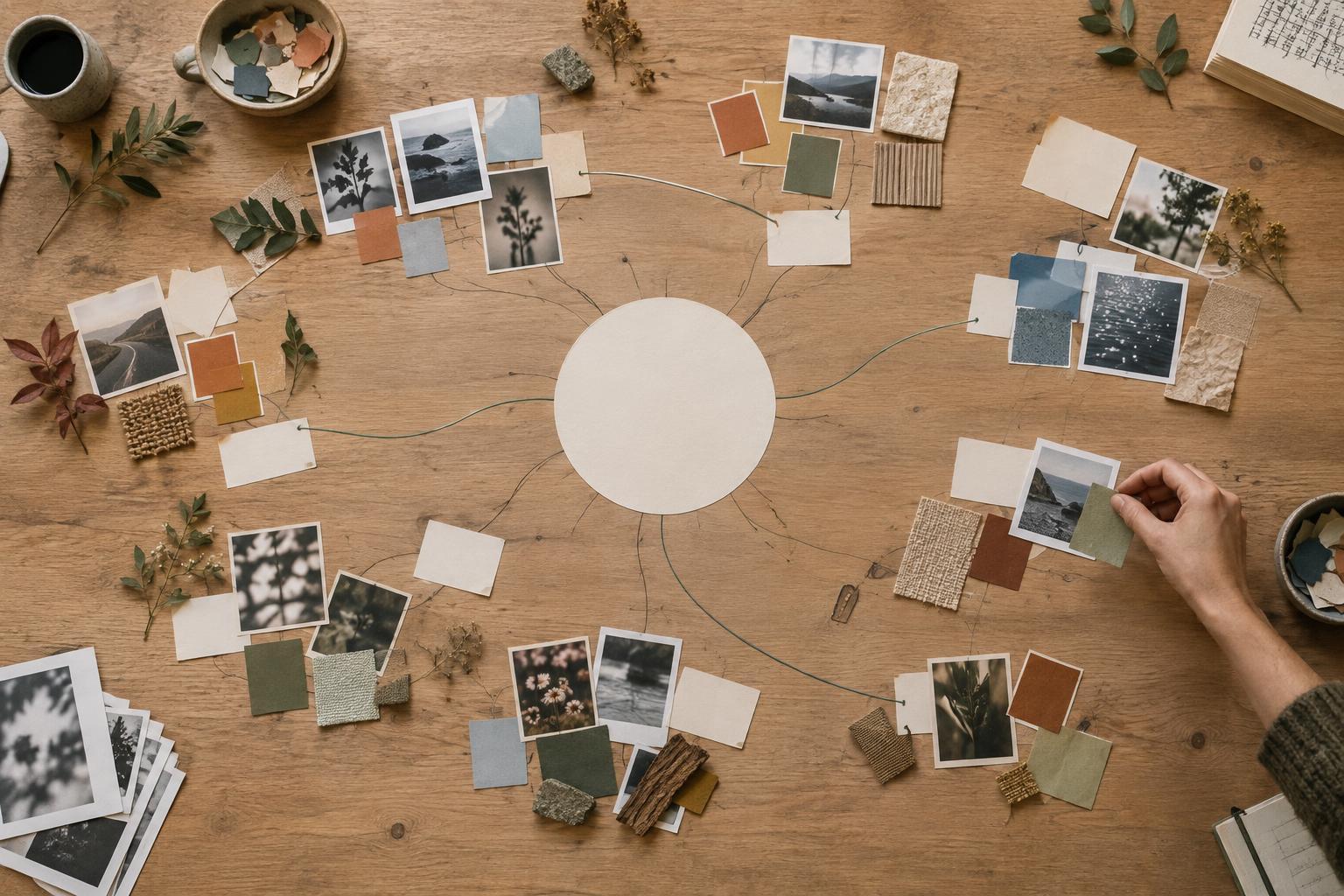
Write your theme in the centre of a large page. If the project has a clear audience or purpose, add it in a corner as a reminder, not as another centre point. For example, a team developing a visual identity for a neighbourhood arts programme might start with “threshold”. They may eventually need a logo and a set of event materials, but those deliverables do not have to dictate the first branches of the map.
Build branches from different kinds of association
Draw several lines outward from the central word and give each a different prompt: physical objects, places, actions, emotions, sounds, opposites and personal memories. Under “threshold”, physical objects might include a doorway, a step and a curtain. Actions could include entering, pausing and welcoming. Opposites might be inside and outside, private and public, or familiar and unfamiliar. The variety matters more than filling every branch evenly.
Keep each entry short. A single word or brief phrase leaves room for the next association; a detailed explanation can make an early thought feel settled. Follow one item into another: “curtain” might lead to concealment, performance and changing light. Then return to a different branch. If you are working with others, let people add ideas without debating them yet. You can question what they mean when you review the map.
Look for links between distant branches
Once the page has several layers of ideas, stop adding branches and look across it. Which two entries seem unrelated at first but suggest an interesting relationship? Draw a line between them and write a short note explaining the connection. “Changing light” and “welcoming” could suggest an identity that gradually reveals information as someone approaches an event. “Step” and “performance” might suggest a series of small stages rather than one formal venue.
Try asking what would happen if one branch shaped another. What would a photograph of “belonging” look like if you approached it through sound? How might “renewal” affect the way a workshop opens, rather than only its visual materials? These questions help move the map beyond a collection of related words. If a link seems surprising but you cannot explain it, keep it visible; you may find its use after exploring other connections.
Turn a connection into something you can test
Circle two or three connections that suit the brief and describe each in one sentence. Focus on what the project might do, not just what it might resemble. For the arts programme, “the identity acts as an invitation to cross a threshold” gives the team more to work with than “use doors as a motif”. It could guide the sequence of information on a poster, the framing of photographs and the language used to welcome participants.
Make a small test for each connection. Sketch three poster layouts, collect a few possible photo compositions, or draft the opening of a workshop exercise. Compare the tests with the audience, purpose and practical constraints. Does the idea communicate clearly? Can it work across the required formats? A connection that looks exciting on the map may be difficult to use; another may become stronger when you give it a concrete form.
Keep the map available as the project develops
A mind map does not need to be tidy or complete. Its value lies in showing how you reached a direction and where you might go if that direction stops working. Save the map alongside your sketches and note which links led to tests. When presenting an idea to a collaborator or client, you can share a few relevant connections to explain your reasoning without walking them through every branch.
If you get stuck later, return to the map with a more specific question. You might ask which unexplored association could shape a photographic detail, a transition between pages or a workshop prompt. Add new branches if the brief has changed, but do not feel obliged to preserve every early idea. The aim is not to prove that the map contained the final answer. It is to create more routes toward a useful one.