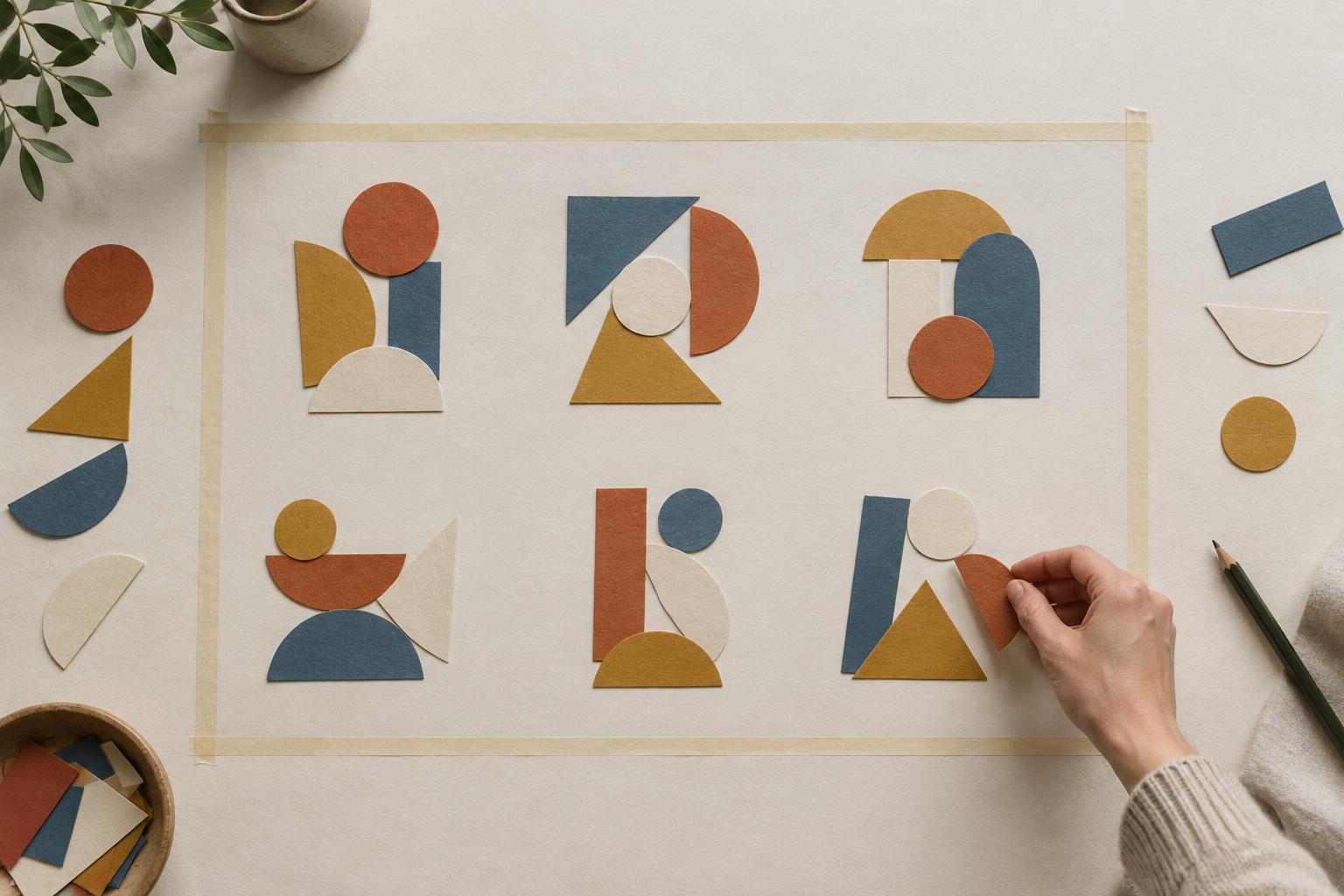
Start with the decision you need to make
A blank brief can feel full of possibility, but it can also leave every decision open at once. Should the work be playful or restrained? Should you explore type, imagery, colour or structure first? A creative constraint reduces the number of decisions you face at one time. The useful kind does not tell you exactly what to make; it gives you a clearer problem to solve.
Before choosing a constraint, name the decision that is slowing you down. A designer developing an identity might be unsure how the brand should sound visually. A photographer might have plenty of subjects but no consistent point of view. A workshop team might be generating ideas without knowing how to compare them. Each situation calls for a different boundary. “Use only two colours” may help the designer explore contrast, but it will not resolve an unclear audience or purpose.
Choose a boundary with a reason behind it
Good constraints connect to the work’s purpose. They may come from the audience, the setting, the available materials or the way the finished piece will be used. For a visual identity that must work on small labels, legibility at a modest size is a meaningful constraint. For a series of portraits made in one workspace, using the same backdrop may help viewers notice differences in gesture and expression.
It helps to distinguish a practical requirement from a creative experiment. A fixed delivery format may be unavoidable; a limited colour palette is usually a choice. Both can shape the work, but you can change only one of them freely. Write down which boundaries are fixed and which you have introduced yourself. This keeps an optional rule from becoming so familiar that nobody thinks to question it.
Phrase each chosen constraint as an invitation to explore. Instead of “do not use photography,” try “communicate the idea through type and shape first.” Instead of “make everything minimal,” try “remove any element that does not help a first-time viewer understand the message.” The second version gives you something to evaluate, rather than a style to imitate.
Leave room for more than one answer
A constraint sharpens ideas when it creates a productive question. “How many distinct layouts can we make using one typeface?” invites variation. “Make every layout look like this reference” leaves little to discover. If your rule seems to point toward only one acceptable result, loosen it or move it to a different part of the process.
Try pairing one firm boundary with one open variable. You could keep the format fixed while exploring tone, or keep the message fixed while changing composition. For a small campaign, a team might use the same headline across three concepts but test a direct, playful and quiet visual approach. Comparing those options is easier because one element stays stable.
Avoid stacking too many rules at the start. A short timeline, limited palette, fixed grid, single typeface and ban on photography may leave little space for a meaningful choice. Begin with the one or two constraints most closely tied to the project’s problem. Add another only when you can explain what it will help you learn.
Test constraints with a short making exercise
You do not have to debate a rule in the abstract. Give it a brief trial. Set a modest time limit and produce three clearly different responses within the chosen boundary. Keep the exercise rough enough that you can change course without feeling attached to a polished result.
For example, when planning a photography series about everyday tools, choose “photograph each object where it is normally used” as the trial constraint. Make three images with different framing and light. Then ask what the rule reveals: does the setting add context, or does background clutter make the object harder to see? If the setting matters but the clutter does not, refine the rule to “include one visible clue to the object’s use.”
A workshop can use the same approach. Give small groups a shared prompt and one constraint, such as explaining an idea without specialist language. After a quick round, compare the results against the intended audience. The aim is not to declare a winning idea immediately. It is to see which boundaries help people make and discuss concrete choices.
Keep, revise or remove the rule
After a trial, assess the constraint separately from the quality of any single draft. Did it make the work easier to start? Did it produce distinct options? Did it help you explain why one direction serves the project better? An awkward first attempt does not necessarily mean the rule failed; you may need another round. But if every result feels forced in the same way, the boundary may be too tight or aimed at the wrong problem.
Record the outcome in one sentence: “Keeping one typeface helped us compare hierarchy,” or “The fixed grid made the illustrations difficult to read.” This creates a useful record of decisions without turning the process into a long report. Constraints are tools, not promises. Keep the ones that bring the project’s purpose into focus, and change the ones that merely make the work harder.