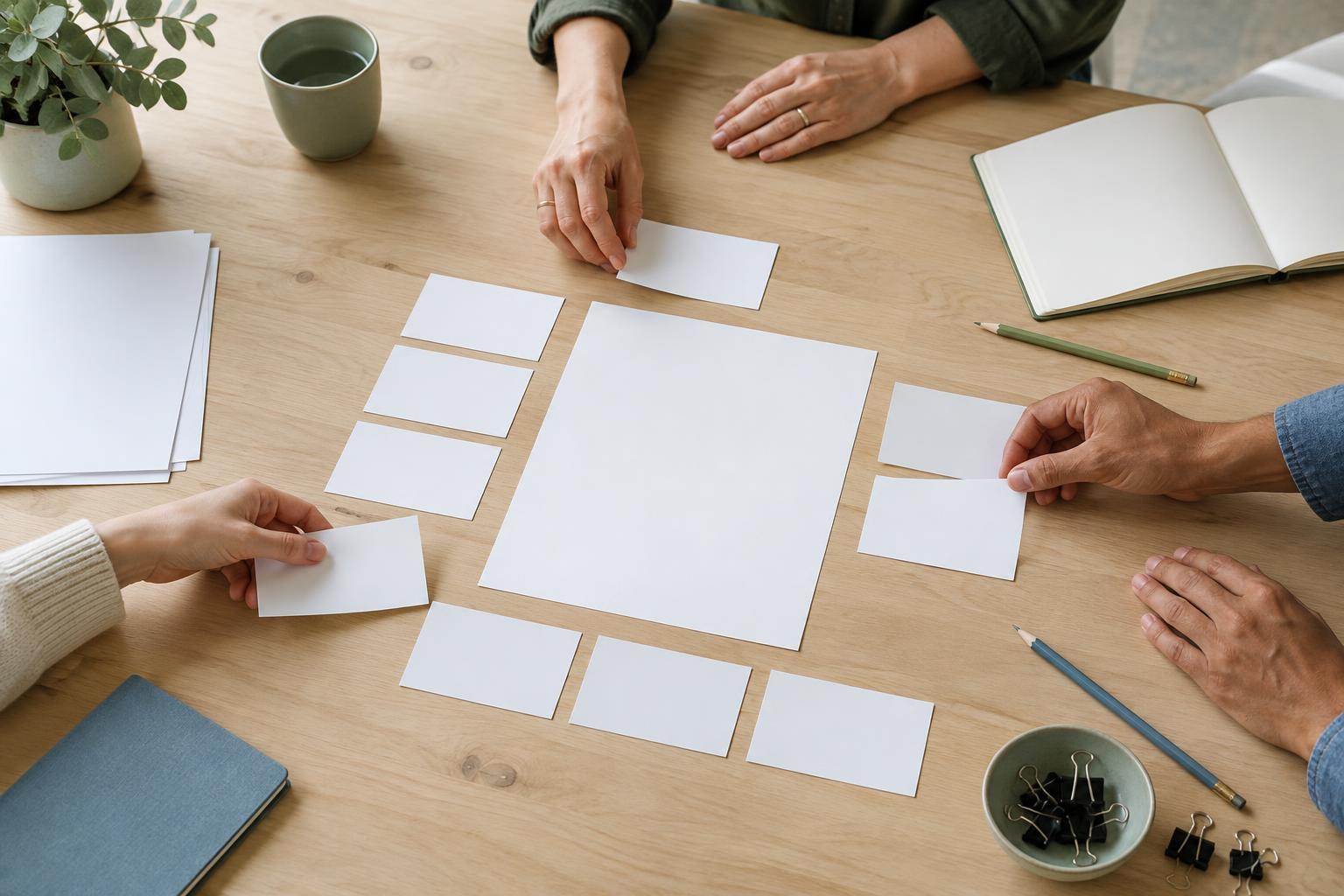
Start with the decision the workshop needs to support
Before writing an agenda, ask what needs to be different after the workshop. A team might need to choose a direction for a visual identity, agree on the audience for a campaign or identify what a photography series must communicate. “Explore the brand” is too broad to guide a session. “Which of these three identity directions best expresses the studio’s character?” gives participants something specific to examine and compare.
Write the central question as a sentence that can be answered through discussion and simple exercises. It should be open enough to invite ideas but narrow enough to fit the available time. If the question contains several separate decisions, split them up. A workshop can generate input for a later decision, but the brief should say so rather than imply that every issue will be resolved in one room.
Define an outcome people can use afterward
A useful outcome is more concrete than “shared understanding.” It might be a ranked set of design principles, an annotated shortlist of concepts or a list of unanswered questions with owners. Describe the form the output will take and what it will be used for next. For example: “We will leave with two preferred identity directions and written reasons for choosing them; the designer will use those notes to develop the next round.”
Also name what the workshop will not produce. A session that selects a promising direction is not necessarily approving finished artwork. Making that distinction in the brief protects the time needed for later design work and helps participants give feedback at the right level. If someone else will make the final choice, explain how the workshop output will inform that choice.
Give participants enough context, not a reading assignment
The brief should state why the workshop is happening now, who it is for and what has already been decided. A short note on constraints can prevent the group from spending time on options that are unavailable. For an identity workshop, useful context might include the intended audience, where the identity will appear, any existing assets that must remain and the stage of the project.
List participants by role or contribution, rather than inviting everyone who has an interest in the project. A person who understands the audience may bring a different perspective from someone who will make the designs. Ask for only the preparation the session genuinely needs: perhaps one example of work that communicates the desired tone, with a sentence explaining why. If no preparation is required, say that too.
Match the exercises to the question
Once the question and outcome are clear, choose activities that move toward them. If the group needs to compare identity directions, begin with a quiet individual review so each person can form an opinion before discussion starts. Then ask participants to note what each direction communicates, where it feels strong and what concerns it raises. Grouping those notes can reveal points of agreement and questions that need testing.
Put a simple sequence in the brief: introduction, individual work, discussion, synthesis and closing decision or recommendation. Include approximate time for each stage, but leave room to adjust. The agenda is a tool for reaching the outcome, not a promise to complete every exercise. If discussion becomes repetitive, the facilitator can return to the central question and ask what evidence or example would help the group move forward.
Plan how the result will be captured
A workshop can feel productive and still leave a team unsure what was agreed. Decide before the session who will record decisions, reasons, concerns and unresolved questions. Photographs of notes may help preserve detail, but a short written summary is usually easier to act on. Separate agreed points from ideas that were merely mentioned so later readers do not mistake a suggestion for a decision.
End the brief with the next step: who will share the summary, who will review it and what piece of work follows. A compact brief can fit on one page if it answers six questions: Why are we meeting? What is our central question? What will we produce? Who needs to participate? How will we work? What happens next? Those answers give a creative team enough structure to do useful work without prescribing the ideas it should find.