Start with the decision the workshop needs to support
A workshop agenda is more than a list of exercises. It is a route from what participants know at the start to something they can use at the end. Before assigning minutes, write one sentence describing the intended output: for example, “We will leave with three visual directions to explore” or “We will agree on the questions our photography brief must answer.” An output you can point to is easier to plan for than a broad aim such as “generate ideas.”
Next, decide what participants need to do to reach that output. A visual identity workshop might move from reviewing the brief, to generating associations individually, to comparing themes, to choosing directions for further development. Each step should earn its place. If an activity does not help people understand the problem, contribute ideas or make the next decision, remove it or save it for another session.
Estimate the full cost of each activity
An activity rarely begins the instant its name appears on the agenda. People need to hear the prompt, ask clarifying questions, open a shared document or move to a wall of notes. At the end, they may need to label their work and make it visible to others. When estimating time, include those actions alongside the main exercise. A ten-minute brainstorm, for instance, may need several additional minutes to introduce and collect.
Discussion is especially easy to underestimate. If six people each have two minutes to share an idea, their contributions alone take twelve minutes; questions and comparisons take longer. Decide whether everyone needs to speak about every idea. A short written review or a round in which each person shares one observation can preserve participation without filling the session with presentations. For an unfamiliar exercise, allow more time for instructions and a small example.
Build the agenda backward from a clear close
Reserve closing time before filling the middle of the agenda. Participants should know what was decided, what remains open and who will take the next step. Without a close, even an energetic discussion can leave the team unsure whether a direction was chosen or merely mentioned. Five minutes may be enough to read back a short list of decisions; a complex brief may need longer to check agreement.
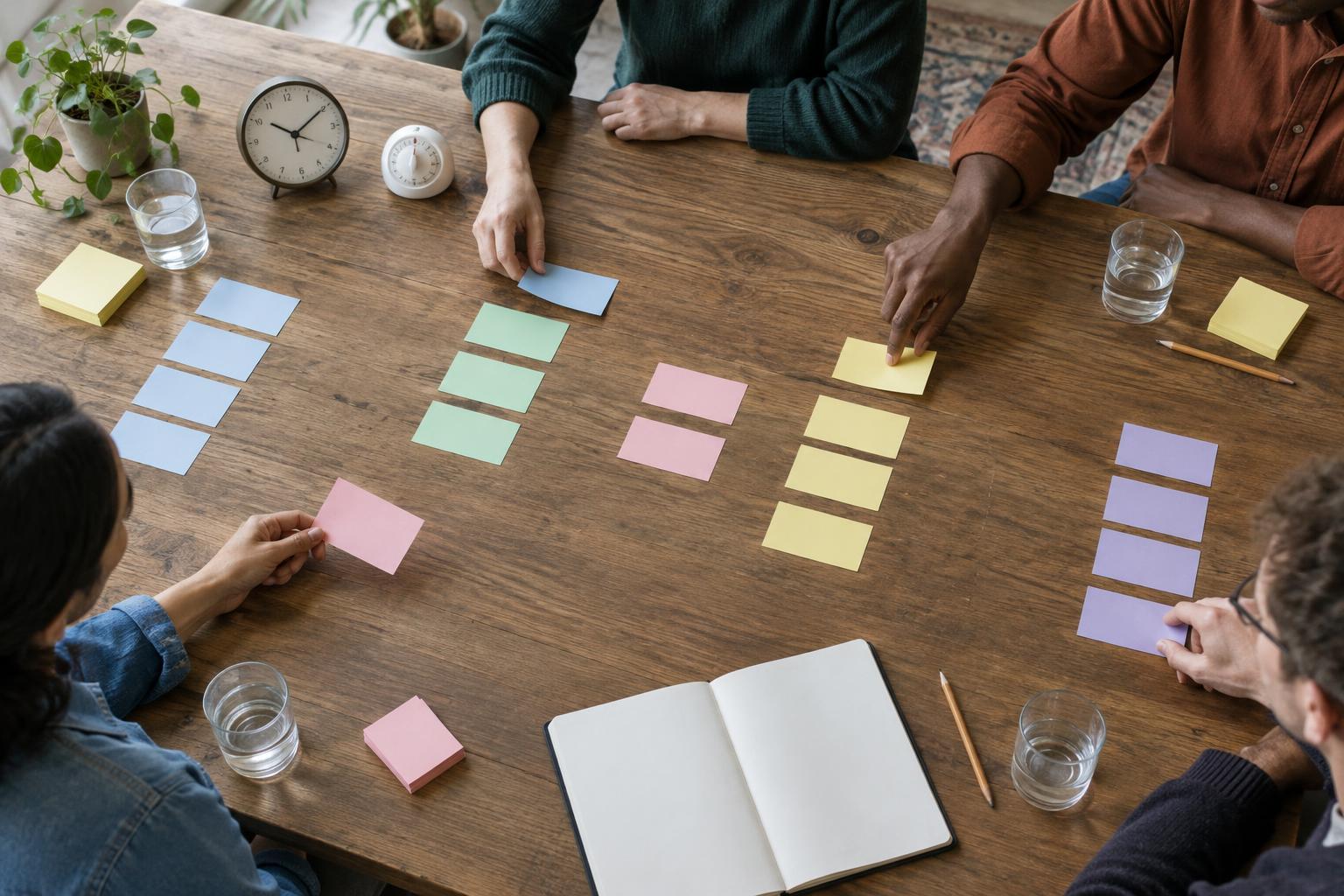
Here is a possible 90-minute agenda for a small team developing visual directions: welcome and outcome, 10 minutes; review the brief and constraints, 10; individual idea generation, 15; share and group ideas, 20; discuss promising directions, 20; choose what to develop, 10; recap owners and next steps, 5. The total is 90 minutes. The sharing block includes time to put ideas where everyone can see them, while the final two blocks turn discussion into a usable result.
Plan for transitions, breaks and uneven energy
The example agenda is compact. If people must switch rooms, set up materials or log into different tools, give those transitions their own minutes rather than hoping they happen in the background. For a longer workshop, include a break and state when it ends. A break is not lost time: it gives participants a chance to return to a demanding discussion with attention to spare.
Vary the kind of effort across the session. Individual writing gives quieter participants space to form a view before group discussion begins. A focused comparison works better when ideas have already been made visible. If an agenda relies on continuous open conversation, it can become tiring and hard to steer. Alternate between making, sharing and deciding, and keep prompts narrow enough to fit the time available.
Give the facilitator a way to adjust
Even a carefully timed agenda is an estimate. Mark one activity as expandable and identify one that can be shortened without losing the intended output. If idea generation finishes early, use the spare minutes to clarify promising options. If discussion runs long, reduce the number of ideas examined rather than sacrificing the decision and recap. A visible timer and a brief warning before each activity ends help participants finish their thoughts.
After the workshop, compare planned time with actual time. Note where instructions took longer, where people needed more individual thinking and where discussion became repetitive. Use those observations to improve the next agenda. Realistic timing does not mean predicting every minute perfectly; it means making deliberate choices so participants have enough room to do the work that matters.