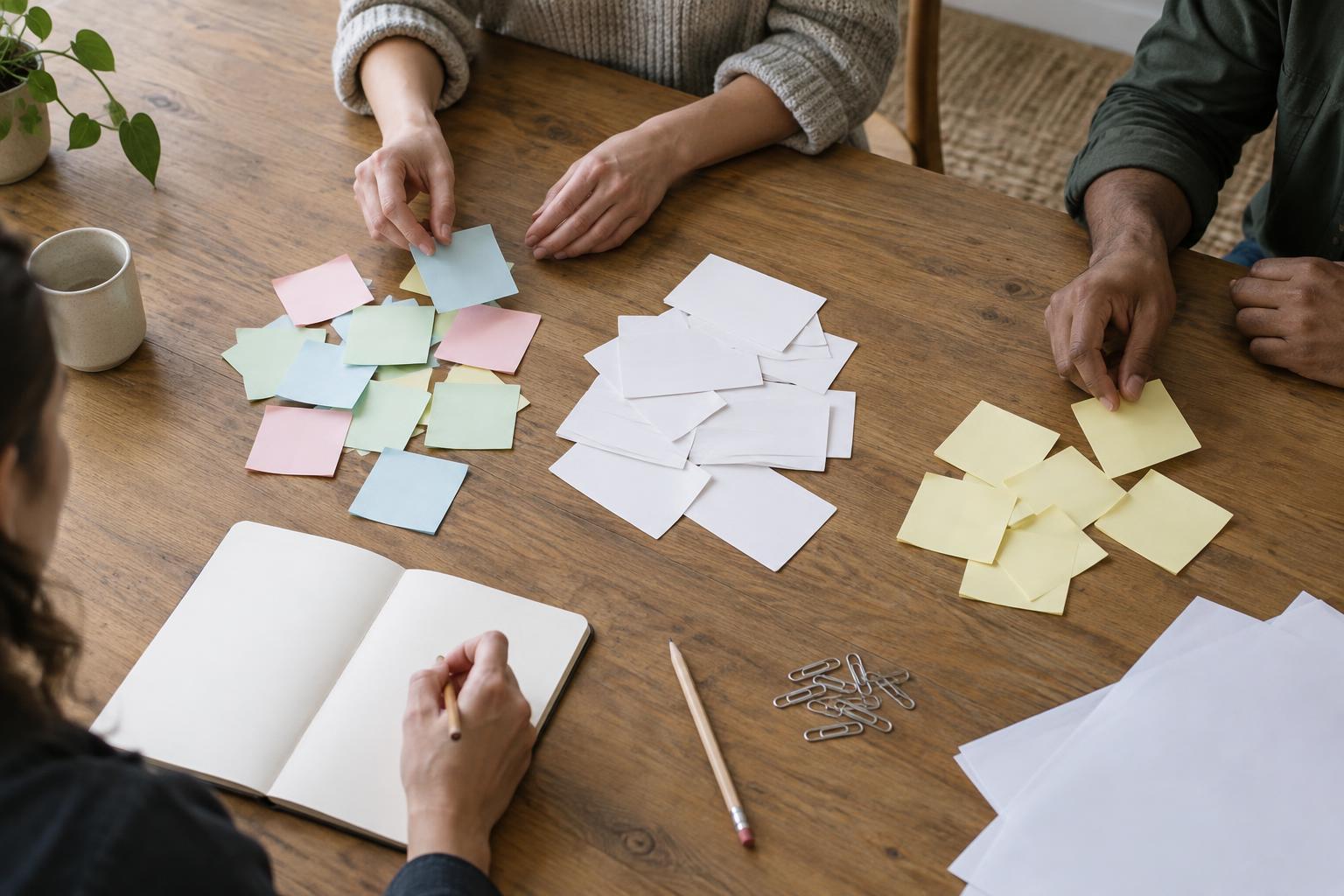
Decide what the record needs to do
A workshop can generate sketches, comments, disagreements and promising directions in a short time. Photographing everything may preserve the room, but it rarely tells someone who was not there what happened. Before the session, decide who will use the record and for what purpose. A design team developing a visual identity may need to understand which concepts to explore. A client team may need to see what was agreed, what remains uncertain and what they need to review.
Set up one shared document with four areas: ideas, decisions, open questions and next steps. Add the workshop goal, the date, the participants’ roles and a brief description of the activities. Keep the structure visible during the session so people can check whether their contributions are being captured accurately. If the workshop is exploratory, say so: a shortlist of possibilities is not the same as an approved direction.
Capture ideas without pretending they are final
During activities, record ideas in the language participants use, then add just enough context to make them understandable later. “Make it warmer” is hard to act on alone; “Use warmer colour and more candid photography to make the service feel approachable” is more useful. Note which exercise produced an idea and, where relevant, which audience or problem it addresses. For sketches, give each one a short label that matches a note in the document.
Cluster related contributions after an activity rather than transcribing every repeated comment. A cluster might be “ways to show movement” or “concerns about legibility.” Keep contrasting views visible when they reveal a real design choice. Do not turn a participant’s question into a team preference or present a lively discussion as consensus. A simple label such as “idea to test” helps protect early suggestions from being mistaken for commitments.
Write decisions with their reasons and boundaries
A decision entry should answer three questions: what was decided, why, and what the decision applies to. For example: “Explore the simpler wordmark first because it remains readable at small sizes; keep the illustrated version as an option for campaign materials.” This is more useful than “Team liked option B.” Record whether a decision is final for this stage, provisional pending a test, or a recommendation awaiting approval.
Before moving on, read important decisions back to the group. Ask whether the wording reflects what they meant and whether anyone understands the scope differently. This brief check can reveal that people agreed to test a direction, not to adopt it. Where a decision-maker was absent, record the proposed direction as a recommendation rather than an approval. Clear boundaries make it easier to revisit a choice without reopening the entire workshop.
Give unanswered questions a route forward
Open questions are useful outputs, not gaps to hide. Phrase each one so that someone can investigate it. “What do we think about the photos?” is vague; “Can the existing product photos support the more editorial layout?” points toward a review. Where helpful, add what would answer the question: a quick prototype, feedback from a stakeholder, a check of available assets or a comparison of two approaches.
Assign an owner and a review point to questions that affect the next stage. The owner is responsible for bringing back an answer or a proposed way to decide; they need not solve it alone. Separate questions that block progress from those that can wait. If the group could not agree, record the competing options and the criterion that might help resolve them, such as clarity for a particular audience.
Turn the workshop record into a working document
Soon after the session, organise the notes while their context is still clear. Start with a short summary of the goal, the leading ideas, the decisions and the most consequential open questions. Then add the detail: labelled images of sketches or boards, concise notes from each exercise, and a next-step list with owners. Check that images are readable and that their labels match the written record. If photographs include people or material not intended for wider sharing, consider who needs access before circulating them.
Send the record to participants with a clear invitation to correct misunderstandings. Corrections should clarify what happened, not quietly rewrite the outcome. Keep the document available as the project develops, and mark later decisions with new entries instead of erasing earlier ones. That way, the team can see how an initial idea became a tested direction, why a choice changed, and which questions still need attention.