Start with a question, not a folder of favourites
Saving images is easy; remembering why you saved them is harder. Before collecting references for a project, write down the decision you need to make. You might be exploring how to give a small brand a warm visual tone, how to photograph a reflective object, or how to make dense information easier to scan. A specific question turns browsing into investigation and gives you a reason to stop.
Create a small collection for that question rather than adding everything to one endless folder. Include examples that solve the problem in different ways, along with a few that do not quite work for your purpose. For each item, note where it came from, who made it if known, and the particular feature that caught your attention. Keeping that context makes it easier to revisit the reference and to credit its creator when appropriate.
Describe the principle behind what you like
A reference becomes more useful when you translate a reaction such as “I like this” into an observation. Instead of saving a poster because it looks energetic, note that its energy comes from tight cropping, an uneven rhythm of type sizes, and a limited palette. Instead of saving a photograph for its mood, consider the direction of the light, the amount of empty space, and the relationship between subject and background.
Separate transferable principles from distinctive choices. “Use contrast to establish a reading order” is a principle you can test in many ways. Repeating another designer’s exact layout, colour combination, illustration style and headline treatment is much closer to reproducing their solution. Your notes should help you understand how a piece works, not become a set of instructions for rebuilding it.
Collect beyond your immediate style
If every saved item comes from the same kind of project, your next project may start to resemble that narrow set of examples. Broaden the library with material from other contexts: packaging for an editorial layout, exhibition signage for a workshop handout, or still-life photography for a digital identity. You can also collect everyday observations, such as the way a shop groups products or a notice makes its most important message visible.
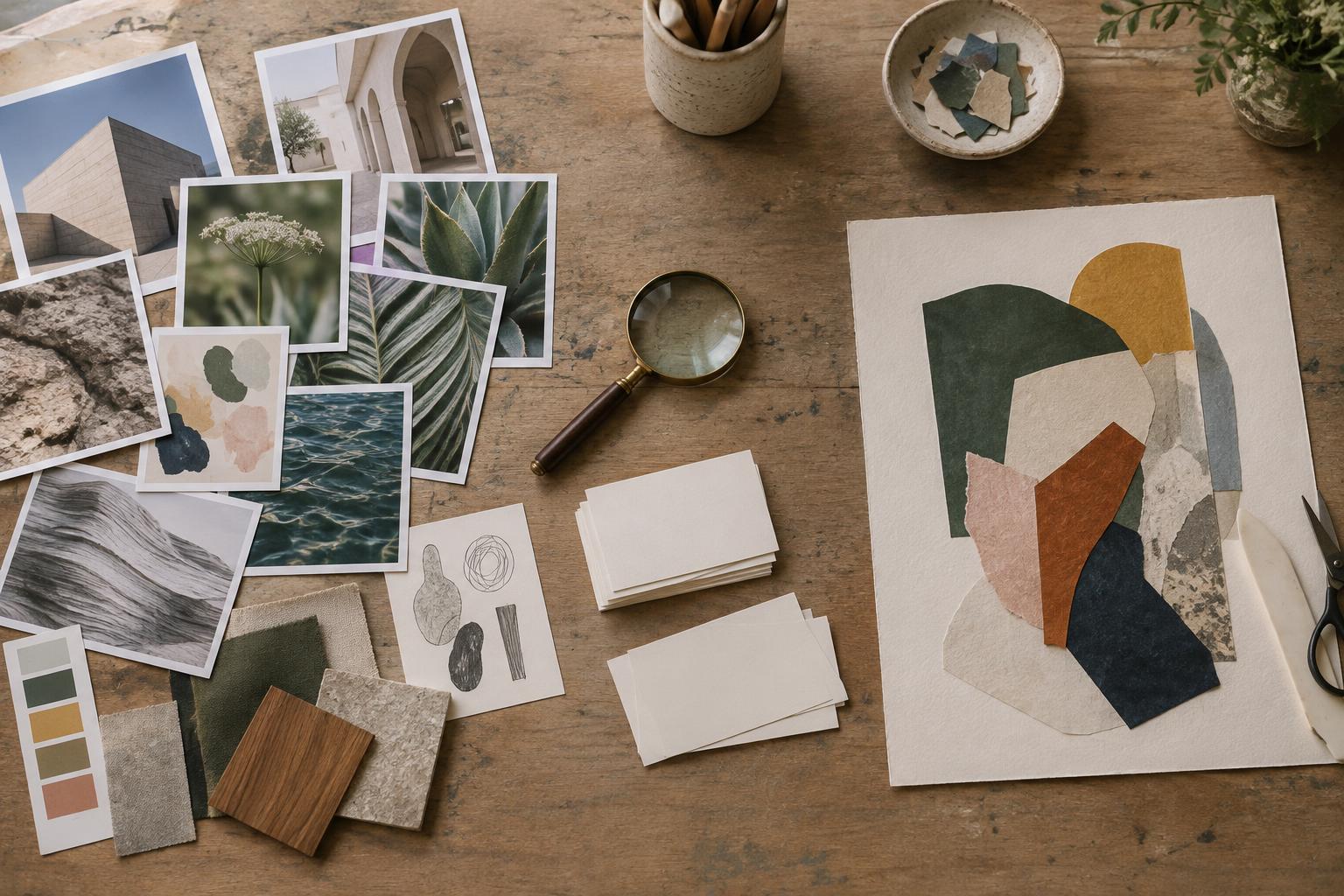
Give references simple labels based on what they demonstrate: hierarchy, pacing, colour, composition, texture, interaction or tone. A single item may fit several labels. This is often more useful than sorting only by medium or creator, because a future project might call for “quiet but clear” rather than “more posters.” Include your own sketches, experiments and photographs too. A library should record what you have noticed and tested, not only what others have finished.
Put distance between the reference and the draft
When it is time to make something, close the reference collection for a first round of ideas. Write a short brief describing the audience, purpose, constraints and tone. Then sketch several approaches from that brief without looking at the examples. This pause gives your own priorities room to shape the work, while the principles you observed remain available in your notes.
Afterward, reopen the library to check a specific question: Does the composition have enough contrast? Could the lighting better reveal the object’s shape? Avoid using a reference as the template for an entire outcome. If a draft feels unusually close to one source, change more than a surface detail. Reconsider its structure, viewpoint or concept, and compare it with several different references rather than one dominant example.
Review the work and keep the library useful
A quick comparison can reveal similarities that are hard to see while making. Place your draft beside the references that influenced it and ask which decisions came from the project brief and which came from a particular example. Look at the overall arrangement as well as small details. If someone who knew the source might immediately recognise its distinctive combination of choices, treat that as a prompt to develop another direction.
Finally, add a short note about what you tried and what you learned. Remove duplicates, update unclear labels and keep links or creator details with the references you retain. Over time, the library becomes a record of your thinking rather than a stockpile of images. Its value lies in helping you ask better questions, make deliberate decisions and communicate the reasons behind your own work.