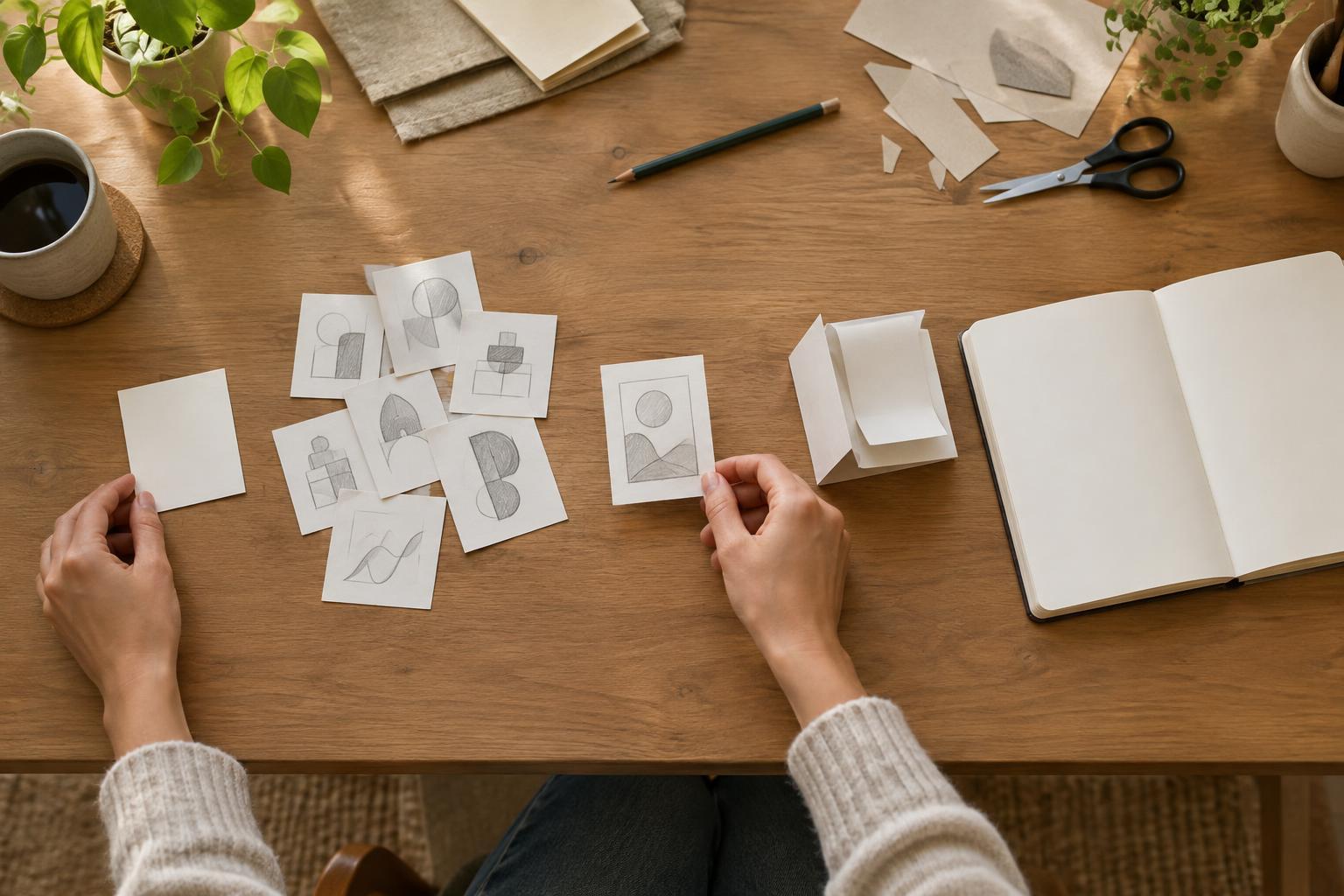
Start with a prompt you can act on
A solo ideation session does not need a perfect brief. It does need a question specific enough to suggest what you might make. Before opening a sketchbook or design file, write down the audience, the intended effect and any important constraints. If the task is to promote a neighbourhood repair workshop, “make a poster” describes an output. “How might a poster help first-time visitors feel welcome and understand what they can bring?” gives you something to explore.
Add what is known and what remains uncertain. You may know the poster will appear in a shop window but not know which message matters most to visitors. Keep those uncertainties visible rather than quietly treating assumptions as facts. Then choose a modest session goal, such as producing three possible communication approaches, not a finished design. This gives you a stopping point and makes it easier to judge whether the session was useful.
Set up a small working space
Give the session a beginning, middle and end. For example, you might spend a few minutes framing the prompt, a longer stretch generating possibilities, then reserve time to select, develop and reflect. Treat the timings as guides, not deadlines to obey at the expense of a promising thought. What matters is protecting time for each activity: it is easy to keep generating ideas until there is no room to examine them.
Choose tools that make rough work easy. Paper and a pen are enough; a digital canvas can work if it does not tempt you to polish too early. Put the prompt where you can see it, alongside a short list of constraints. Create separate areas for raw ideas, promising directions and questions to revisit. Keeping those areas distinct helps you avoid mistaking your first workable idea for your only option.
Generate options before judging them
Start by making several deliberately different responses to the prompt. For the repair workshop poster, one direction might use a reassuring step-by-step message; another might lead with a playful image of familiar broken objects; a third might focus on the satisfaction of learning a skill. Write a one-sentence description or make a tiny sketch for each. Aim for differences in approach, not just variations in colour or type.
When ideas begin to repeat, change the question. Ask what someone would need to know before attending, what might make them hesitate, or how the message would change if it had to work without an image. You can also invert an assumption: if you have been showing tools, try showing people or outcomes instead. Record awkward ideas too. They may reveal a useful angle once separated from their first execution.
During this stage, postpone detailed critique. A brief note such as “unclear audience” is enough; you can test that concern later. The purpose of generating is to give yourself material to compare, not to prove that every idea deserves to survive.
Choose a direction and make it tangible
Now return to the prompt. Which option best helps the intended audience, and which could you explore within the project’s constraints? Select one direction to develop and, if useful, keep a second as an alternative. Write down why you chose it. A reason such as “the step-by-step approach explains what to expect” is more useful than “it feels right,” because you can check it against the next version.
Make the chosen idea tangible at the lowest level of effort that will answer a question. For a poster, that might be a rough layout with a headline, image placeholder and essential information. For a workshop concept, it could be a short outline of what participants do first, next and last. Do not refine details that the concept has not earned yet. Instead, ask whether someone unfamiliar with your thinking could understand the main message from what is on the page.
Close with reflection and a next step
End the session by looking at what you made, not just what you intended to make. Note the strongest idea, the decision that shaped it and one unresolved question. Distinguish between a problem you can solve alone and one that needs input from someone else. If you are unsure whether first-time visitors understand the poster, the next step may be to show the rough layout to a potential visitor rather than continue adjusting it in isolation.
Save a brief record: the original prompt, your rough alternatives, the selected direction and the reason for choosing it. This record makes it easier to resume the project or explain your thinking to a collaborator. A productive solo ideation session does not have to end with a polished answer. It should end with clearer options, a visible line of reasoning and a practical way forward.