Start with a question, not a finished look
Material exploration is a way to find ideas by handling and changing physical things. Instead of trying to make a polished composition, you cut, fold, layer, arrange or photograph supplies to see what happens. It can be useful at the beginning of a visual identity, editorial, packaging or content project, when a mood is easier to describe than a design is to draw.
Give the exercise a question connected to your project. For example: “What could make this identity feel welcoming without looking childish?” or “How might we show movement using only paper?” A question offers direction while leaving room for surprises. If you are working with others, agree on one question everyone can return to when deciding which experiments are worth developing.
Gather supplies and set useful limits
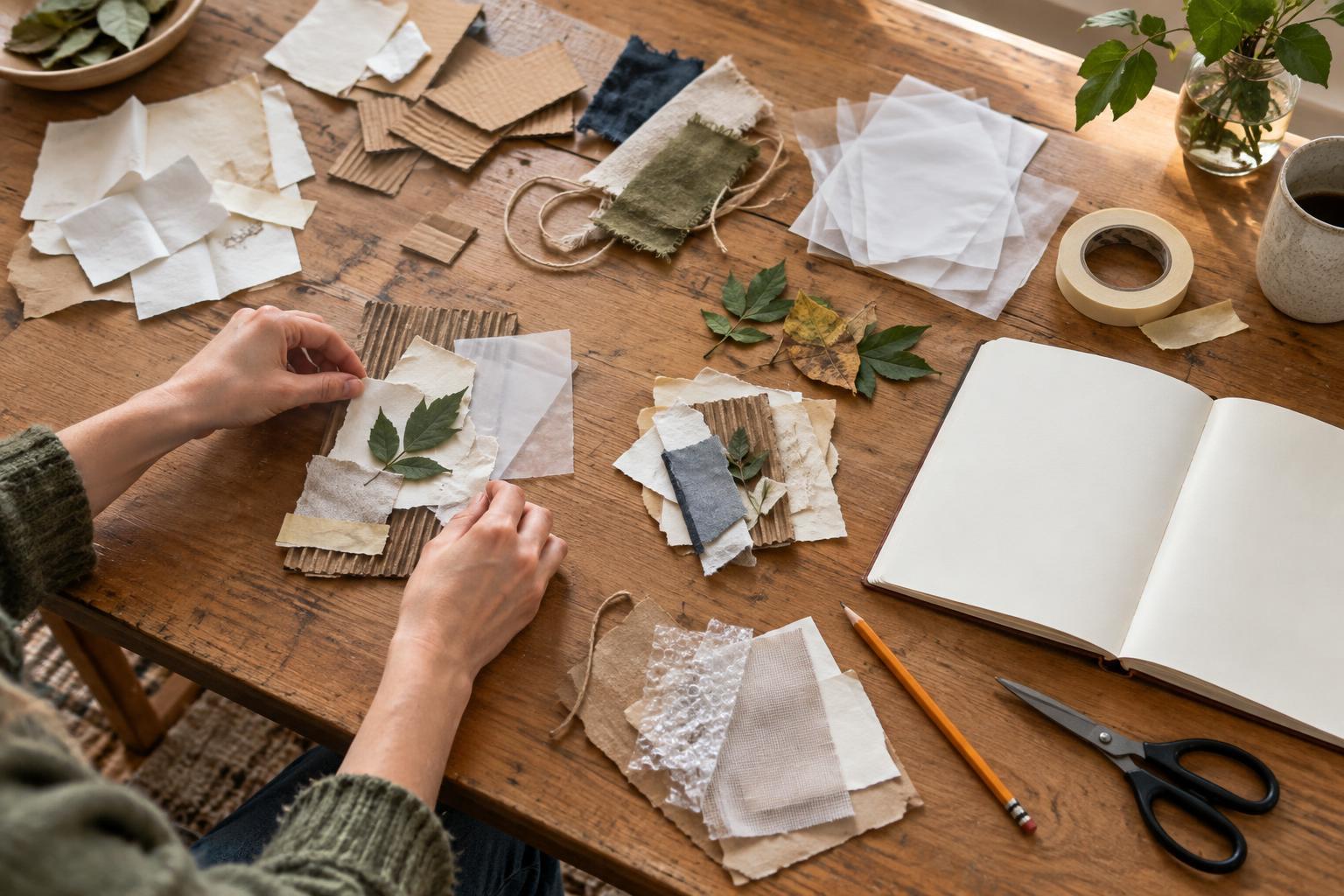
Choose materials that are easy to handle and replace: scrap paper, cardboard, envelopes, string, tape, pencils, fabric offcuts and packaging. A phone camera can help you record arrangements that will not last. Set out a clear work surface and keep a container nearby for scraps. If you use scissors or adhesives, choose options suited to the people taking part and the space available.
Limits make the activity easier to begin. Try allowing only three materials and four actions, such as tearing, folding, layering and casting shadows. Ask participants to make several quick studies rather than one carefully finished object. If the exercise is for a team, offer a choice of actions: someone who finds cutting awkward might prefer arranging, drawing or photographing. The aim is to open up possibilities, not to test craft skills.
Make variations before choosing a favorite
Begin with a small prompt: create a surface, shape or arrangement that answers the project question. Work quickly enough that an unpromising idea does not feel costly. Change one feature at a time. A folded sheet might become more rhythmic when repeated, more inviting when curved or more dramatic when lit from the side. Put each variation beside the previous one so the differences remain visible.
Then change the scale or point of view. Photograph a tiny detail up close, or arrange several pieces across a larger area. Look at the spaces between objects as well as the objects themselves. If you are in a group, let everyone work independently first; afterward, invite people to build on a promising variation. This gives quieter ideas a chance to emerge before the group settles on a shared direction.
Resist judging the results only by whether they look attractive. An awkward experiment may reveal a useful texture, a repeatable gesture or an unexpected color relationship. Keep a few attempts that did not work as intended and note what they taught you.
Record what you notice
Before clearing the table, photograph the experiments in consistent light and capture a few close views of interesting details. Give each promising variation a short label, such as “overlapping edges” or “soft shadow grid.” Labels based on observable qualities are more useful than vague judgments like “good” or “bad.”
Review the work against your starting question. Which studies suggest a visual principle you could reuse? A row of torn edges might suggest a way to divide a page; a photographed shadow might suggest an approach to image-making. Ask each participant to name one result that fits the brief and one that challenges their assumptions. If people disagree, record the different readings rather than forcing an immediate consensus.
Turn the discoveries into a next step
Select two or three ideas to test in the format the project actually needs. You might translate a paper arrangement into a layout sketch, try a texture behind type or use the exercise to plan a photography setup. Check whether the idea still works when it must carry real content and remain clear at the required size. A striking tabletop experiment is a starting point, not automatically a finished design.
Keep the photographs, brief notes and a few material samples together. They form a record of how a direction developed and make it easier to explain choices to collaborators or clients. If none of the results feels useful, revisit the question or change one constraint and run a shorter second round. The value of the exercise is not a perfect object on the table; it is a clearer set of possibilities to test.